
Best Portable & Mobile Chicken Coops (Chicken Tractors)
Best portable and mobile chicken coops (chicken tractors) for rotating pasture, tiered by flock size and price, with the run-space math for wheeled coops.
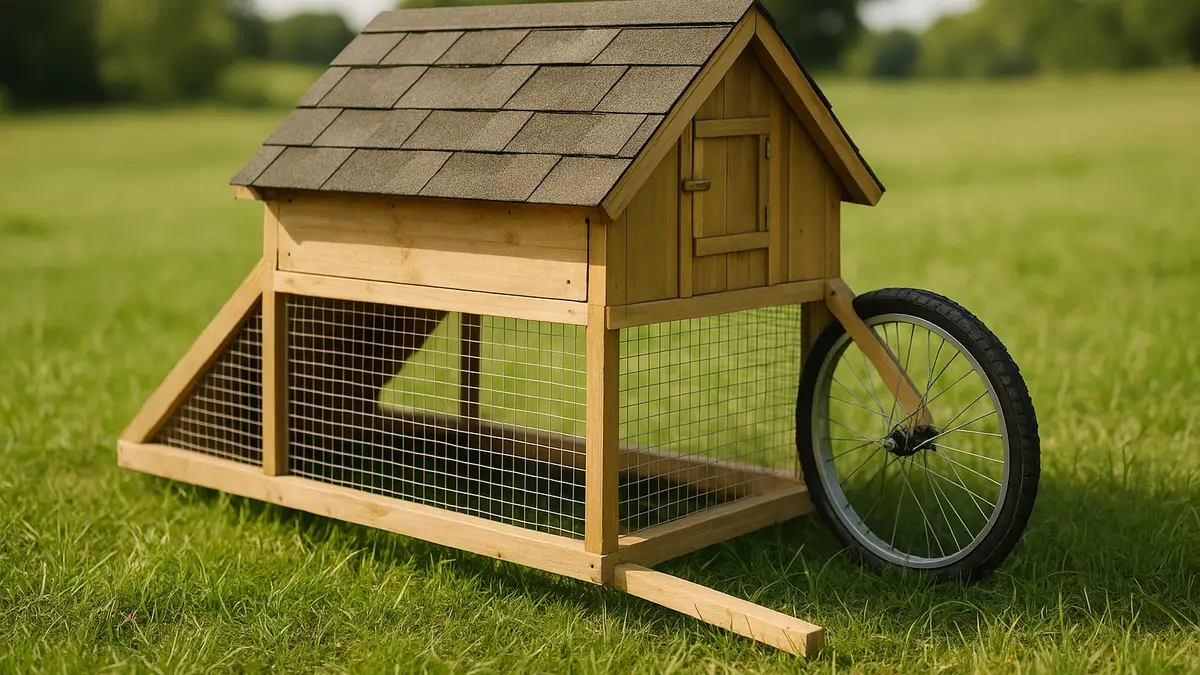
A portable chicken coop trades some structural permanence for fresh ground every day, which matters if pasture rotation, lawn fertilizing, or bare-dirt prevention is part of why you’re keeping chickens at all. Chicken tractors and mobile coops solve a different problem than a stationary coop, and they’re priced differently too.
What makes a coop “portable”
A chicken tractor is a coop-and-run combination built to be relocated regularly, usually on wheels or skids, with a wire-bottom or open-bottom run that lets birds reach fresh grass at each new spot. That’s different from a stationary coop with wheels bolted on for occasional repositioning; true tractors are designed around daily or near-daily moves, and the run floor construction reflects that.
The ranking
| Tier | Price | Flock size | Best for |
|---|---|---|---|
| Small tractor | $200-450 | 2-4 hens | Suburban yards, lawn rotation |
| Mid tractor | $450-900 | 6-8 hens | Homesteads with real pasture |
| Large tractor | $900+ | 10+ hens | Serious pasture rotation, multiple moves/week |
Small tractor ($200-450)
Small tractors fit the same 2-4 hen flock as a stationary small coop but add wheels or a skid frame, usually one wheel axle at the back and lift handles at the front. Inside space still needs to hit the 8 sq ft floor even at this size; some ultra-compact tractors undersize the coop box to keep total weight moveable by one person, worth measuring before buying. Who this is NOT for: anyone without actual rotatable ground, a small fixed yard gets little benefit from wheels over a stationary coop with a slightly bigger run.
Mid tractor ($450-900)
This tier covers 6-8 hens with a run in the 50-80 sq ft range and typically a proper two-wheel or dolly-wheel system built for regular moves rather than occasional ones. Run floor should still be wire-bottom or fully open, not solid, since the entire point is fresh ground contact. Who this is NOT for: flat suburban lots without pasture to rotate across; a stationary mid-size coop with a slightly larger fixed run does the same job for less money if there’s no ground to move onto.
Large tractor ($900+)
Large tractors for 10+ birds need real wheel hardware, tow-behind axles or built-in dolly wheels rated for the combined weight of frame, run, and birds. At this size a tractor becomes closer to farm equipment than a backyard purchase, and the premium over an equivalent stationary large coop reflects that. Who this is NOT for: anyone moving the coop alone without mechanical assistance; confirm the wheel and handle design supports one-person moves before buying at this scale.
Predator-proofing a coop that moves
A moved coop can’t rely on a buried hardware-cloth footer the way a stationary run can, since the whole point is relocating it. That makes wire gauge and closure quality matter more, not less: use the same half-inch hardware cloth standard as a fixed coop, and check every seam and door latch after each move rather than assuming yesterday’s predator-proofing carried over. The full fencing and footer approach, including what to do at each new location, is in the predator-proofing guide.
Run space still follows the same math
Moving the coop doesn’t change how much space birds need while they’re in it; the 8-10 sq ft/bird fenced-run figure still applies for the hours between moves, dropping to around 4 sq ft/bird only if the birds also get supervised free-range time beyond the tractor’s footprint. Undersizing a tractor’s run to save weight is the most common mistake, since a smaller, lighter frame is easier to move but crowds the flock every single day instead of just on move day.
How much ground a rotation actually needs
Pasture rotation only works if there’s enough total ground to rotate across; a tractor moved daily across a yard too small to let grass recover just spreads the same bare-dirt problem around instead of solving it. As a rough planning number, treat each move as needing roughly the same square footage as the run itself, so a full rotation cycle back to the starting spot takes as many days as there are run-widths of usable ground, less in a small yard, more on real pasture. Anyone working with a genuinely tight lot is usually better served by a stationary coop with a slightly larger fixed run than by a tractor with nowhere real to go.
Weather and ground conditions
Wheels and skids both struggle in mud, and a tractor stuck after heavy rain defeats the entire point of daily moves. Skid-based tractors generally handle uneven or soft ground better than small caster wheels, which can bog down or dig in on wet grass. Check the undercarriage design against your actual yard conditions, not just the flock size, before buying; a wheel system built for a flat, dry suburban lawn may not hold up on a homestead with real mud season. Whatever the base, plan to skip moves during the worst stretches of wet weather rather than forcing a move that damages the ground more than staying put would.
When a stationary coop makes more sense
If the yard is small, flat, and already grassed the way you want it to stay, a stationary coop with a properly-sized run does the same welfare job without the wheel cost or the weekly moving chore. Chicken tractors earn their premium specifically on pasture rotation, lawn fertilizing across a larger yard, or keeping ground from going bare under a fixed run. If that’s not the goal, the small or large stationary guides will get more coop for the same budget.
Frequently asked questions
Quick answers to what keepers ask us most
What is a chicken tractor?
A wheeled or skid-mounted coop with an attached wire-bottom run, designed to be moved across pasture regularly so the flock gets fresh grass and the ground doesn't get stripped bare in one spot.
How often should you move a portable chicken coop?
Daily to every few days for a true tractor setup. Moving less often defeats the purpose, since the run space still needs the same 8-10 sq ft/bird the ground can support before it gets stripped.
Are portable coops safe for predators?
Only if the wire gauge matches a stationary coop's standard, half-inch hardware cloth, not lighter mesh, since tractors sit lower and lack a buried or L-footer barrier at each new location.
Can one person move a chicken tractor alone?
Small tractors (2-4 birds) generally yes, with handles or a single wheel axle. Mid and large tractors usually need a real wheel-and-handle system or a second person; check the wheel spec before buying if you'll be moving it solo.