
Chicken Coop Size Guide: How Big Should It Be?
How big a chicken coop should be, worked by hand: 3-4 sq ft of inside space per bird, 8-10 sq ft of run, nesting box and roost math, breed adjustments, and a free coop size calculator.
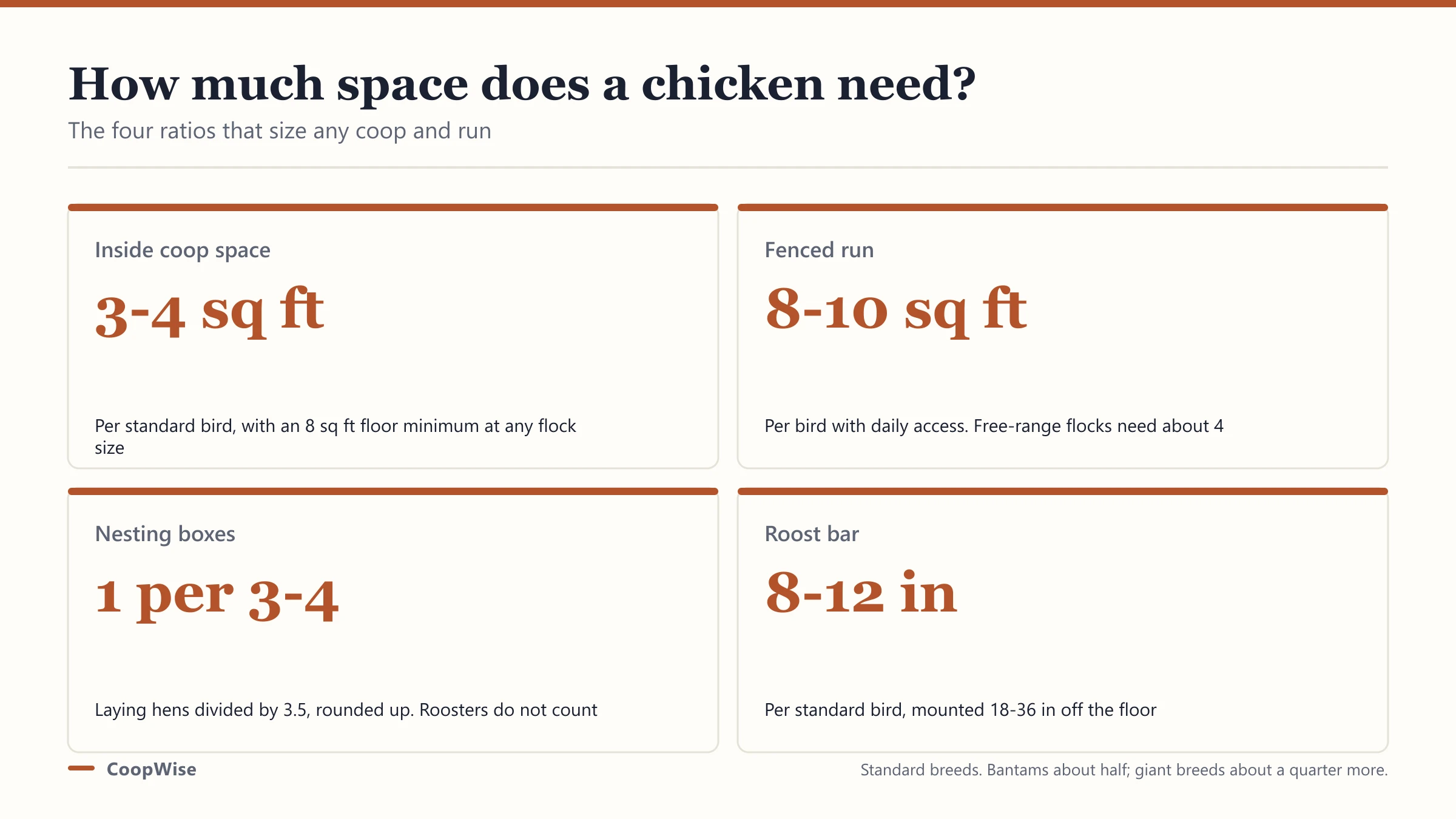
Undersizing the coop is the single biggest reason flocks end up stressed, pecking each other, or laying eggs on the floor instead of in the box. The math behind coop, run, nesting box, and roost sizing is four simple ratios multiplied by flock size and breed, nothing more. Here’s every number, worked by hand, plus where to run it automatically.
How much space does a chicken coop actually need?
A chicken coop is the enclosed structure where chickens sleep, lay eggs, and shelter from weather, sized primarily by inside floor space rather than the capacity number printed on the box. The baseline most keepers and extension offices agree on is 3-4 sq ft of inside space per standard-size bird, with a hard floor of 8 sq ft regardless of flock size, since anything smaller is cramped in practice even for 1-2 birds. Run space, nesting boxes, and roost bar length scale off the same bird count using their own separate ratios below.
Inside coop space: the 3-4 sq ft rule
| Flock size (standard birds) | Inside sq ft | Suggested footprint |
|---|---|---|
| 2 | 8 (floor applies) | about 3x3 ft |
| 4 | 12-16 | about 4x4 ft |
| 6 | 18-24 | about 4x5 to 4x6 ft |
| 10 | 30-40 | about 5x7 to 5x8 ft |
| 15 | 45-60 | about 6x8 to 7x9 ft |
Multiply flock size by 3 for the low end and 4 for the high end. A 6-hen flock needs 18-24 sq ft; a 10-hen flock needs 30-40 sq ft. Below 8 sq ft, round up to the floor no matter what the flock math says, since that minimum applies even to 1-2 birds.
Run space depends on how much they free-range
Run space is the fenced outdoor area attached to the coop, and its per-bird requirement swings more than coop space does because it depends on how much time birds spend outside a fixed enclosure. A flock that free-ranges most of the day only needs about 4 sq ft per bird of run, since it’s a loafing and dust-bath spot rather than the main outdoor area. A flock with daily but limited access needs 8-10 sq ft per bird, the standard constant. A flock confined to the run full time needs 15 sq ft per bird, extra buffer because the run is the only outdoor space available all day.
| Run type | Sq ft per bird | 6-hen example |
|---|---|---|
| Free-range most of the day | 4 | 24 sq ft |
| Fenced run, daily access | 8-10 | 48-60 sq ft |
| Confined, no free-range time | 15 | 90 sq ft |
How many nesting boxes do you need?
A nesting box is a dedicated, enclosed laying spot, sized and counted at 1 box per 3-4 laying hens. The formula is boxes = ceil(laying hens ÷ 3.5), rounded up, with a minimum of 1 regardless of flock size. Only laying hens count toward this number, not roosters. Box size scales to breed: 12x12x12in for standard breeds, 10x10x10in for bantams, 14x14x14in for giant breeds, mounted 18-20in off the floor, lower than the roost bar.
Roost bar: how much linear space per bird?
Roost bar is the horizontal perch space chickens need to sleep shoulder to shoulder without crowding, and the rule is 8-12in per standard bird (bantams 6-8in, giant breeds 12-14in), mounted 18-36in off the floor, higher than the nest boxes. Past about 6 linear ft, split into two or more parallel bars instead of one continuous run; a single long bar concentrates the pecking order at one end and leaves lower-ranking birds without a spot.
Breed size changes every number above
| Breed size class | Inside space vs. standard | Run and roost adjustment |
|---|---|---|
| Bantam | about half, roughly 2 sq ft/bird | scale every number by about 0.5x |
| Standard | 3-4 sq ft/bird (baseline) | 1x, the numbers above apply directly |
| Large/Giant (Jersey Giant, Brahma) | about 4-5 sq ft/bird | scale by about 1.25x |
None of the ratios above are breed-neutral. Bantams need about half the standard footprint everywhere, coop, run, and roost alike; large and giant breeds like Jersey Giants and Brahmas need about a quarter more across the board. A mixed flock should be sized to its biggest bird, not an average across breeds.
Worked example: sizing a coop for 6 standard hens
Take a flock of 6 standard hens with a fenced daily-access run. Inside space: 6 x 3-4 sq ft = 18-24 sq ft, comfortably over the 8 sq ft floor, so a footprint around 4x5 to 4x6 ft works. Run space: 6 x 8-10 sq ft = 48-60 sq ft, roughly 7x8 to 7x9 ft fenced. Nesting boxes: ceil(6 ÷ 3.5) = 2 boxes at 12x12x12in, mounted 18-20in up. Roost bar: at 8-12in per bird that’s 48-72in, 4-6 ft, one bar is fine since it’s right at the 6 ft split point. That’s a complete coop and run spec built from four ratios and one flock size, no guessing involved.
Skip the math: run your own numbers
Every ratio above holds for any flock size and breed mix, but multiplying four separate ratios by hand gets tedious past the first example. The coop size calculator runs all four, inside space, run space, nesting boxes, and roost length, for your exact bird count, laying hen count, breed class, and run type in one pass, and flags overcrowding automatically if the numbers work out too tight. For a fully worked example at a specific flock size instead of doing the math yourself, see chicken coops for 10 chickens.
What does a properly sized coop cost?
| Tier | Flock size | Price |
|---|---|---|
| Small starter kit | 2-4 birds | $150-350 |
| Mid-size walk-in | 6-10 birds | $400-900 |
| Large/premium | 10-20+ birds | $900-2,500+ |
Coop price scales with the same size math above, not just a marketing tier name. Check that a coop’s actual inside square footage, not its “up to X chickens” label, clears the target for your flock size before buying. See small coops and large coops for tier-by-tier picks, or portable coops if mobility matters as much as footprint.
Where the numbers above show up next
Every downstream buying decision, coop kit, feeder placement, nest box style, traces back to the four ratios on this page. If nest box count is the immediate question, the nesting boxes guide breaks the formula down further with box-style comparisons and mounting details. If a flock is about to reach 10 birds, the 10-chicken worked example shows exactly what that spec looks like start to finish, including price-tier recommendations. And whether the plan is a kit or a from-scratch build, the size math doesn’t change either way, it only changes what’s holding it together.
Frequently asked questions
Quick answers to what keepers ask us most
How many square feet does a chicken coop need per bird?
3-4 sq ft of inside space per standard-size bird, with a hard 8 sq ft floor regardless of flock size. Bantams need about half that, giant breeds like Jersey Giants need about a quarter more. Run space is separate, 8-10 sq ft per bird in a fenced daily-access run.
How big should a chicken run be for 6 chickens?
48-60 sq ft for a fenced run with daily outdoor access, using the 8-10 sq ft per bird rule. Less if the flock free-ranges most of the day, more if the run is their only outdoor space. Try other flock sizes in the coop size calculator.
Do bantams need a smaller coop than standard chickens?
Yes, roughly half the inside space, run size, and roost length of a standard bird. Nest boxes shrink less, 10x10x10in versus 12x12x12in, since the box still has to fit a nesting hen comfortably.
How many nesting boxes does a 6-hen flock need?
2 boxes, using the ceil(laying hens ÷ 3.5) formula. That same ratio covers 5-7 hens at 2 boxes and jumps to 3 at 8 hens. Full box-size and placement details are in the nesting boxes guide.