
Best Large Chicken Coops for 10-20+ Backyard Hens
Best large chicken coops for 10-20+ hens, tiered from $900 walk-ins to $2,500+ premium builds, with the exact inside, run, nest box and roost numbers.
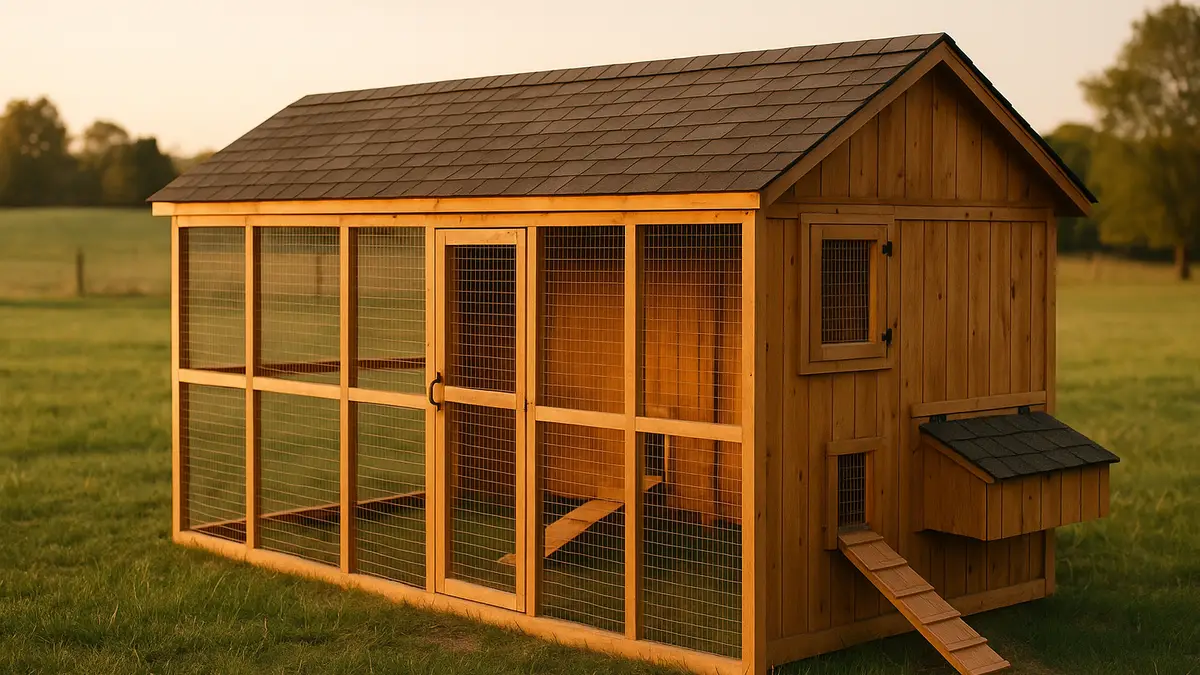
Once a flock crosses 10 birds, coop shopping stops being about a single product and starts being about a build: walk-in access, multiple roost bars, and enough nest boxes that egg collection doesn’t turn into a daily queue. Here’s what 10-20+ hens actually need and what it costs at each tier.
Sizing a large flock’s coop
A large coop is a structure built for 10-20+ standard hens, which at 3-4 sq ft inside and 8-10 sq ft of fenced run per bird works out to 30-80 sq ft inside and 80-200 sq ft of run depending on exact flock size. Nest boxes scale to 3-6 (1 per 3-4 hens), and roost bar length scales to 8-12 linear ft (10-20 birds x 8-12in each), which is exactly the point where splitting into 2-3 parallel bars stops being optional. Confirm your own numbers in the coop size calculator since breed size class shifts every one of these figures.
The ranking
| Tier | Price | Flock size | What you get |
|---|---|---|---|
| Entry walk-in | $900-1,300 | 10-12 hens | Human-height door, 3-4 nest boxes, single long run |
| Mid large | $1,300-1,800 | 12-16 hens | Split roost bars, 4-5 nest boxes, reinforced run frame |
| Premium large | $1,800-2,500+ | 16-20+ hens | Multiple access points, 5-6 nest boxes, insulated or hybrid-material walls |
Entry walk-in ($900-1,300)
This tier is the jump point from mid-size to true large: full walk-in height, a run typically 80-120 sq ft, and 3-4 nest boxes. Who this is NOT for: flocks likely to grow past 14-15 birds soon, since entry walk-ins usually max their run space right around 12 hens under the 8-10 sq ft/bird rule. Check the small coop guide too if you’re not actually at 10 birds yet; buying large early costs more than growing into it.
Mid large ($1,300-1,800)
This is where roost design starts mattering more than raw square footage. Look specifically for coops that ship with two separate roost bars rather than one long run, it keeps the pecking order from concentrating conflict at a single perch. Run space in this tier typically covers 12-16 birds comfortably, and nest box count (4-5) has margin for growth without a queue. Who this is NOT for: anyone assembling alone; large coops at this size routinely need two people for roof and wall panels regardless of kit quality.
Premium large ($1,800-2,500+)
Premium builds add multiple human-access doors (useful for cleaning from both ends), better winter ventilation (ridge vents, adjustable panels), and sometimes insulated or double-wall construction for cold climates. Nest boxes typically hit 5-6, covering flocks up to 20-21 hens without a wait. Who this is NOT for: warm-climate keepers without harsh winters; the insulation and multi-door premium pays off most where cold-weather ventilation and frozen-waterer logistics are a real concern. Pair a premium coop with a heated waterer setup to actually use that cold-climate investment.
Kit vs. custom-built at this size
Past about 15 birds, flat-pack kits get heavy and shipping costs climb fast, custom or locally-built coops become price-competitive with big-box kits once you factor delivery. The coop kits comparison covers what ships included versus what you’ll source separately, hardware cloth upgrades, paint, and predator-proofing are the most commonly missing pieces at this size too.
Don’t skip the roost math
A 20-hen flock needs roughly 160-240 inches, 13-20 linear feet, of roost bar at the standard 8-12in/bird rate. That’s long enough that a single bar becomes a crowding problem on its own, birds pack toward the center and fight over the ends. Budget for 2-3 shorter bars mounted at slightly different heights instead of one continuous run; it’s a cheap fix that most large-coop buying guides never mention.
Cleaning access and deep litter at scale
A 10-20 bird coop produces enough droppings that cleaning method, not just frequency, becomes a real decision. Two approaches dominate: frequent shallow cleanouts (weekly to biweekly, full bedding swap) or the deep-litter method, letting bedding build to 8-12in over a winter season while composting in place, which actually generates some passive heat in cold climates. Deep litter works better at large-coop scale specifically because there’s enough floor area and bedding volume for the composting process to function properly; it tends to fail in small coops where there isn’t enough material or airflow. Whichever method you pick, walk-in height and multiple access doors, standard at this tier, are what make either one manageable without climbing over roosts and nest boxes to reach the far corners.
Water and feed logistics for 10-20+ birds
Flock size at this scale changes equipment math beyond just the coop shell. A 1-gallon waterer or feeder, fine for a small flock, needs refilling multiple times a day for 15-20 birds, which is why the waterer and feeder guides both recommend stepping up to 3-5 gallon galvanized units past roughly 15 birds. Plan for at least two feed and two water stations in a large coop and run rather than one of each; it reduces crowding at a single point and gives lower-ranking birds in a bigger flock’s more pronounced pecking order somewhere to eat and drink without conflict.
Getting the run size right matters more at scale
The gap between a correctly-sized run and an undersized one grows with flock size: a 2-bird mistake is a minor crowding issue, a 20-bird mistake is a mud pit and a stress-driven pecking problem. Use the actual run-type multiplier, free-range loafing space at 4 sq ft/bird, fenced daily access at 8-10, confined at 15+, rather than a single flat number, since a mostly free-ranging flock of 20 needs dramatically less fenced run than a fully confined one.
Frequently asked questions
Quick answers to what keepers ask us most
How big of a coop do I need for 15 chickens?
About 45-60 sq ft of inside space (3-4 sq ft per bird) and 120-150 sq ft of run at 8-10 sq ft/bird. Run the exact numbers, including nest boxes and roost length, in the coop size calculator.
Is a walk-in coop worth the extra cost for a large flock?
Yes past about 8-10 birds. Walk-in access cuts daily cleaning and egg-collection time significantly, and most 10+ bird coops need the headroom for a human to reach the back nest boxes and roosts anyway.
How many nest boxes does a 20-hen flock need?
6 boxes, using 1 box per 3-4 hens (ceil(20 ÷ 3.5) = 6). Fewer boxes causes egg-laying queues and more floor-laid, dirtier eggs.
Should roost bars be one long bar or split up?
Split them. Past roughly 6 linear ft, use two or more parallel bars instead of one long run; it prevents crowding at one end and gives lower-ranking hens somewhere to roost without conflict.