
Best Chicken Feeders: Treadle, Gravity & Auto-Door
Best chicken feeders compared by type, gravity, treadle and auto-door, with capacity sized to flock size and life stage from chick starter to adult layer.
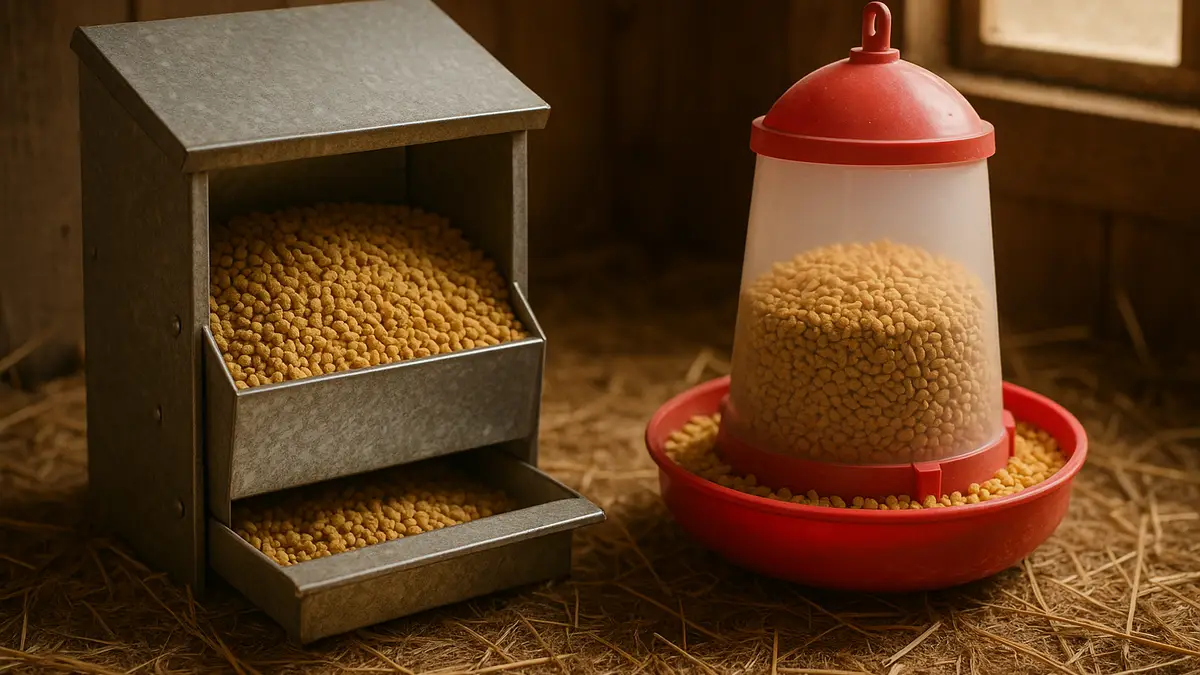
Feeder choice affects two things people underrate: how much feed gets wasted to rodents and wild birds, and how often you’re stuck refilling. Here’s what actually differs between the three main types, and what capacity fits your flock’s exact stage.
The three feeder types
A treadle feeder is a weight-activated feeder with a lid that opens only when a bird steps on the platform, which blocks rats, mice, and wild birds from raiding the feed between chicken visits, the single biggest source of ongoing feed waste in an open feeder setup. Gravity feeders are the simple hopper style, feed gravity-flows down into a lipped tray as birds eat, cheap and reliable but open to pests at all times. Auto-door or timed feeders add a scheduled or sensor-triggered opening, useful for strict portion control or covering short absences without leaving feed exposed around the clock.
The ranking
| Type | Price | Best for | Downside |
|---|---|---|---|
| Gravity | $15-40 | Small flocks, tight budgets | No pest protection, feed exposed to weather |
| Treadle | $60-150 | Most backyard flocks | Higher upfront cost, chicks too light to trigger it |
| Auto-door/timed | $80-200 | Portion control, short absences | Needs power or batteries, more parts to fail |
Gravity feeders ($15-40)
The cheapest and simplest option: a hopper feeds down into a tray by gravity as birds eat from it. Who this is NOT for: anyone with an active rodent or wild-bird problem near the coop, since gravity feeders sit open around the clock and are the easiest target for both. They work fine for flocks in areas with low pest pressure and for keepers who don’t mind a bit of feed waste in exchange for the lowest cost and simplest maintenance.
Treadle feeders ($60-150)
The weight-activated lid is the single best fix for the rodent-and-wild-bird problem that plagues open feeders; chickens step on, lid opens, they step off, it closes. Who this is NOT for: very young chicks, who often aren’t heavy enough to trigger the treadle mechanism reliably, meaning a treadle feeder usually becomes the adult-flock feeder while chicks stay on a separate small unit during the brooder stage. Worth the premium for most established flocks purely on feed savings over a season.
Auto-door/timed feeders ($80-200)
These add a scheduled or motion-triggered opening on top of the sealed-container design, useful when strict portion timing matters or when a short trip means the flock needs a day or two of coverage without a sitter. Who this is NOT for: keepers who want zero maintenance; timed units run on batteries or power and need occasional checking to confirm the mechanism is still firing on schedule, more moving parts than a passive treadle or gravity design.
Sizing capacity to flock and stage
Feeder capacity needs to track the actual feed-consumption ladder, not just bird count:
- Chick stage (0-6 weeks): roughly a 1-quart unit per 6-8 chicks.
- Grow-out (6-20 weeks): a 3-5 quart unit covers 10-15 birds.
- Adult flock: a 1-gallon (4 quart) feeder covers 8-10 birds for a day or two between refills; a 3-5 gallon galvanized unit covers 15-20 birds with less frequent refilling.
An adult standard hen eats roughly 1/4 lb of feed a day, about 1.5-2 lb a week, so a 1-gallon feeder holding roughly 3 lb of pellets empties in 1-2 days for an 8-10 bird flock, plan refill frequency around that rather than guessing. Full life-stage feed type and protein targets are in chicken feed by age.
Feeder placement and coop fit
Feeders belong off the ground on a stand or hung at bird-back height to cut bedding contamination and waste; most treadle and gravity models include a base or hanging bracket for this. Placement also factors into how much floor space a coop actually has free for birds versus equipment, worth checking against your flock’s total footprint in the coop size calculator if the coop is already tight.
Cleaning and feed spoilage
Whatever type you buy, feeders need regular cleaning to stay worth the investment. Damp feed molds fast, especially in gravity feeders where rain or condensation can reach the tray, and moldy feed is a real health risk, not just a waste issue. Check trays weekly for caking or mold, more often in humid climates or rainy stretches, and site the feeder somewhere with at least partial roof cover even in a run without a full structure over it. Treadle and auto-door feeders have a real advantage here too: a closed lid between visits keeps rain and humidity off the feed, not just pests, which is part of why they waste less feed over a season than the raw pest-blocking math alone suggests.
Feeders and waterers are usually a matched decision
Feeder and waterer capacity should scale together since both track flock size and life stage the same way; a mismatched pair, oversized waterer with an undersized feeder, just means uneven refill schedules. The full waterer type-and-capacity breakdown, including heated winter options, is in best chicken waterers, and treat-and-scratch feeding, which needs its own separate container so it doesn’t dilute the layer ration, is covered in chicken treats and scratch.
Number of feeders per flock
One feeder per flock works fine up to about 10-12 birds as long as it’s sized correctly, but larger flocks do better with two feeding stations rather than one oversized unit. Splitting feed access reduces crowding at a single point and gives lower-ranking birds in a bigger flock’s pecking order somewhere to eat without waiting or getting pushed off. It also adds redundancy: if one feeder jams or runs dry, the flock isn’t cut off from feed entirely until someone notices. For flocks under 10 birds, a single correctly-sized feeder is simpler to manage and cheaper without a meaningful downside.
Frequently asked questions
Quick answers to what keepers ask us most
What is the best type of chicken feeder?
For most backyard flocks, a treadle feeder is the best all-around choice: the weight-activated lid keeps out rodents and wild birds, which is the biggest recurring feed-cost leak gravity feeders have no defense against.
How big of a feeder do I need for 10 chickens?
A 1-gallon (4 qt) feeder covers 8-10 adult birds for roughly a day or two between refills, or step up to a 3-5 gallon galvanized unit for less frequent refilling.
Do treadle feeders really keep rodents out?
Yes, the weight-activated platform is calibrated to open under a chicken's weight but not a mouse's or rat's, which is exactly the pest-access problem gravity feeders can't solve.
Can I use one feeder for the whole flock's life, chicks to adults?
No. Chick-stage feeders are sized much smaller, roughly a 1-qt unit per 6-8 chicks, and adult feeders are oversized and wasteful for tiny chicks. Budget for at least two feeder sizes as the flock grows.